

Radiator Valve Reducers and Plastic Heating Pipe: What Must Be Compatible?
Quick answer
Plastic heating pipe needs a permitted combination of pipe, support insert, valve and reducer. Matching the diameter and adding an insert do not make every one-piece reducer compatible.

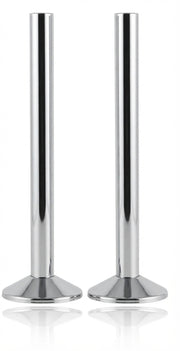
Fitting reference only. Appearance does not confirm dimensions, thread or suitability for a particular valve and pipe.
A radiator valve reducer is suitable for plastic heating pipe only when the complete connection is permitted for that pipe system. Matching the diameter and adding an insert are not enough to establish compatibility.
This guide explains the checks behind the plastic-pipe section of our main radiator valve reducer guide. It is a selection checklist, not a claim that every 8mm or 10mm plastic pipe can use a one-piece brass reducer.
Identify the actual pipe system
Record the manufacturer, product markings, outside diameter and intended heating application. Similar-looking white plastic tubes can have different constructions, internal dimensions and connection requirements. A support insert marked with the same nominal diameter is not automatically the correct part.
If the pipe markings are concealed, supply photographs and any installation records to your installer. Do not choose an insert by pushing different parts into an unidentified pipe to see which feels tight.
A support insert and a reducer do different jobs
A support insert sits inside the plastic tube and supports the pipe wall at the connection. A reducer adapts the compatible valve inlet to the smaller tube size and forms part of the specified joint. Neither part can take over the other’s role.
The pipe manufacturer may require a particular insert design for compression fittings. The permitted arrangement can differ from the one used for the same brand’s push-fit fittings. Use the instructions for the connection being made, not just instructions for the pipe in general.
Check four things together
| Component | What needs confirming |
|---|---|
| Pipe | The identified system, diameter and suitability for the heating application. |
| Support insert | The exact insert specified for that pipe and a compression connection. |
| Valve | The model’s permitted pipe materials, inlet depth and approved reducing arrangement. |
| Reducer and seal | The specified one-piece or multi-part arrangement, including any material restrictions. |
Some plastic-pipe instructions exclude certain olive materials or shallow compression connections. Do not assume that an approval for a copper olive also covers a one-piece brass reducer. If the instructions do not clearly cover the proposed arrangement, obtain confirmation of a permitted alternative before fitting.
Insertion depth matters as well as diameter
The tube must reach the specified stop and the insert must support the required sealing area. An insert that prevents full insertion is not a problem to solve by forcing the nut tighter. Check that all parts belong to the approved arrangement and that the pipe can enter straight without strain.
Do not borrow a tightening torque or turn count from another brand’s instructions. Plastic-pipe support requirements and the fitting’s tightening method need to be considered together.
Where our short videos help
The 8mm and 10mm videos in the main guide’s fitting overview sections show the general preparation, insertion, counterholding and leak-check principles. Their references to approved plastic pipe are conditional: the exact pipe, insert, valve and reducer combination must first be confirmed. The illustrations are not manufacturer installation drawings.
Questions to resolve before ordering
- What is the pipe manufacturer and exact system?
- Which support insert is specified for this compression connection?
- Does the valve permit the proposed reducer and pipe material?
- Are the reducer material and sealing arrangement permitted by the pipe manufacturer?
- Can the pipe reach the required insertion depth without strain?
If any answer is unclear, ask the installer to resolve it before buying. Use the microbore measuring guide to collect a diameter reading without opening the joint, then return to the reducer selection guide with the confirmed specification.

About the Author
Huseyin Aras is a Bathroom Heating & Product Sourcing Specialist at Coventry Towel Radiator with over 18 years of experience in towel radiators, bathroom heating systems, supplier sourcing, and modern home comfort solutions.
About Huseyin and his guides