


Manual vs Thermostatic Towel Radiator Valves UK
Quick answer
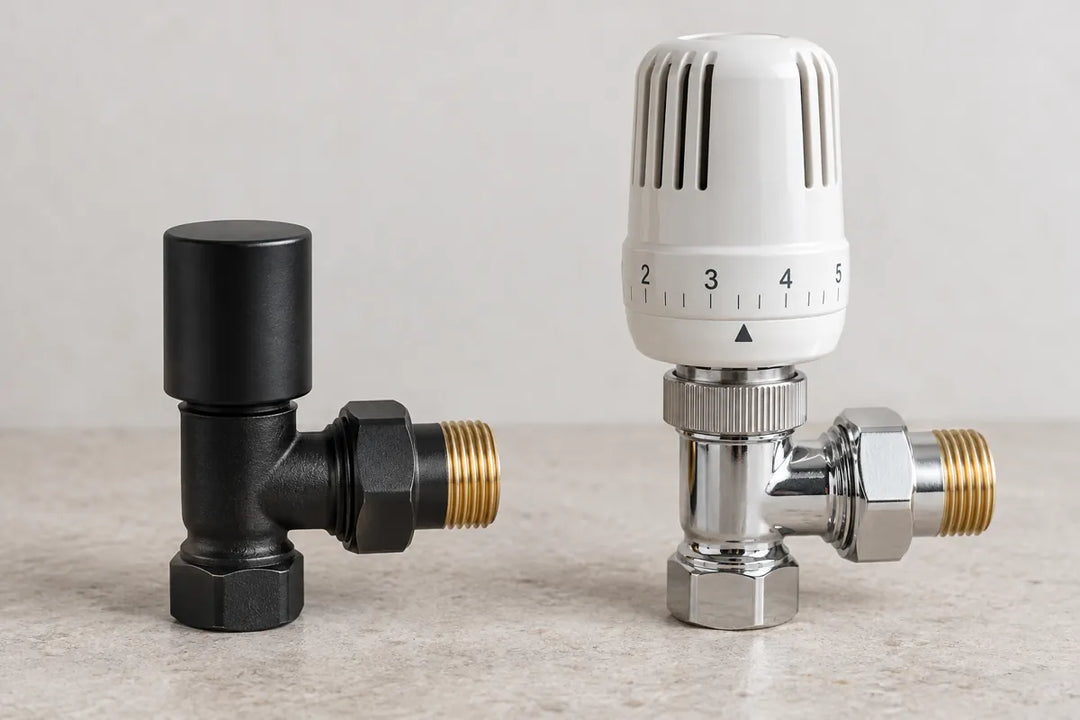
A manual towel radiator valve adjusts water flow when you turn it. A thermostatic radiator valve (TRV) responds to the air temperature around its sensor and adjusts flow automatically. “Angled” and “straight” describe the connection shape, not the control type. Choose control type and pipework fit separately.
Manual valves and TRVs: what changes?
| Feature | Manual valve | Conventional TRV |
|---|---|---|
| How it responds | You adjust its opening by hand. | A temperature-sensitive head regulates water flow. |
| Room-temperature response | No automatic sensing. | Responds to air around the sensor. |
| Turns the boiler on? | No. | Not by itself; smart systems can work differently. |
| Connection shape | Check the specific angled, straight or corner fitting. | Check the specific angled, straight or corner fitting. |
A plain knob is not a thermostat merely because you can turn it. Equally, a valve’s black or chrome finish says nothing about its control function. Read the product specification for an explicit manual or thermostatic description before ordering.
What a thermostatic valve actually controls
A conventional TRV senses nearby air and varies water flow through the radiator. It is not a control for boiler water temperature. A higher setting selects a warmer room target; it does not make the room warm up faster. The sensor needs unobstructed air, so avoid covering it with towels or enclosing it behind furniture. In a bathroom, distinguish the room temperature you want from the towel-drying time you want. If the air is already warm enough for the TRV setting, the valve may restrict flow even when a towel is still damp. That is a reason to discuss your priorities with the installer, not to assume the valve is faulty.
Check the room thermostat and heating-system design
A conventional TRV and the main room thermostat perform different jobs. The first regulates an individual radiator; the latter can stop the heating demand. Drayton advises that the radiator in the main thermostat’s room should not normally have a TRV, subject to the controls’ instructions. Ask your installer how your particular arrangement should work.
Do not assume a bathroom towel rail must always remain open as a bypass. Minimum-flow requirements and any bypass provision depend on the boiler and system design. Ask the installer to check the manufacturer’s requirements before changing the valves or control arrangement. This guide is a buying comparison, not a redesign of your heating circuit.
Smart radiator controls may communicate with a compatible hub or boiler controller. Their capabilities and compatibility are model-specific; a standard TRV should not be described as providing those features.
Angled or straight is a separate choice
Look at where the radiator connection points and where the pipe approaches it. A straight valve provides an inline path; an angled valve changes direction. The correct choice depends on that geometry, rather than an automatic rule that every wall pipe or every floor pipe uses one type.
Our angled versus straight radiator valve guide deals with fitting shape. Our towel radiator pipe-centre measuring guide explains the separate spacing measurement. A matching finish cannot compensate for the wrong connection layout.
For dual fuel, separate the valve from the electric control
A water-side manual valve or TRV does not normally control the electric element. When the central-heating circuit is off, the electric operating procedure and element controls govern the approved electric mode. Do not adjust both radiator valves using a generic summer rule; obtain the instructions for the exact complete assembly.
Our 200mm-wide × 600mm-high black electric towel radiator listing separates standard, round thermostatic and smart digital electric elements from the included dual-fuel radiator valves. “Thermostatic element” does not mean that a thermostatic water valve is included. Confirm both specifications before ordering.
Use the heating-type comparison for the package decision, the preparation checklist for assembly, and the cost formula for electric running time.
A practical UK buying checklist
- Identify the fuel type. These water-flow valves concern central-heating connections. Electric-only temperature control comes from the electrical element and its controls.
- Decide what you want to control. Discuss room-temperature regulation and towel-drying needs with the installer.
- Confirm pipe size and radiator thread. Do not confuse pipe diameter, connection thread and pipe-centre distance. Ask whether an appropriate reducer is needed for microbore pipework.
- Check physical clearance. Allow for the valve body and, for a TRV, the larger head and sensor airflow. Consider access beside a toilet, basin or cupboard.
- Confirm the complete set. Establish what is supplied for the other side of the rail, including the balancing arrangement, rather than assuming every pair is identical.
- Check flow direction and installation instructions. Have the installer confirm compatibility before fitting.
The current 200mm-wide black towel rail and 300mm-wide chrome towel rail offer “without valves”, “with straight inline valves” and “with angled valves” selections. Those option names identify package choices; they do not, by themselves, establish thermostatic control. Confirm the supplied valve specification before relying on a particular control feature.
Browse towel radiator valves and fitting accessories alongside the intended radiator. For a tight wall, compare narrow towel rails with valve clearance included in your measurements.
Common valve questions
Will a TRV make my towel rail heat faster?
A higher setting does not speed up warming. The heating system and available radiator output determine how quickly the room warms.
Is a manual valve always the right choice for a bathroom?
No single choice fits every system. Consider room controls, drying needs and installation requirements with your installer.
Can I swap a manual valve for a TRV myself?
A valve-body replacement involves the water circuit, not simply exchanging a decorative knob. Ask a competent installer to confirm fit, isolation, system requirements and commissioning.
Why is the towel rail cold even with the valve turned up?
The heating may not be calling for heat, or there may be a circulation, air or valve problem. Use our cold towel radiator troubleshooting guide to distinguish the basic symptoms before requesting help.
Related heating and control decisions
Return to the central-heating, electric and dual-fuel comparison for the overall choice. If an electric element is being considered, use the conversion compatibility checklist and running-cost calculation before ordering.

About the Author
Huseyin Aras is a Bathroom Heating & Product Sourcing Specialist at Coventry Towel Radiator with over 18 years of experience in towel radiators, bathroom heating systems, supplier sourcing, and modern home comfort solutions.
About Huseyin and his guides